Pages

Tuesday, June 25, 2024

J.R. Ellis, THE BREWERY MURDERS (Yorkshire Mystery #9)


Set in a small town in Yorkshire, with two artisanal breweries (run by a brother and sister respectively), a long-lost recipe, a full cast of suspects, two detectives, three murders, and human beings with realistic baggage – addictions, tempers, secrets, old resentments. It’s an enjoyable, quick read (one day for me) with a solid moral compass in DCI Oldroyd. (Between the setting and the gentle humanity, I found myself thinking of the James Herriot books.) Oldroyd's underling Andy Carter explains to him, “I used to believe that criminals were evil people. ‘Catch and lock ‘em up’ was my attitude. But you’ve taught us to think differently: that people who do bad things are mostly damaged themselves and maybe they were trapped in circumstances where another person might have behaved in the same way. Something pushed them over the edge. … You’ve taught us to put ourselves in the shoes of the criminal: they’re human, like the rest of us and mostly think the same way.” I also enjoyed the interesting facts about brewing and its history. This is my first mystery by Ellis, and I'll look for others.

Monday, June 24, 2024

Judith Flanders, THE INVENTION OF MURDER


Brilliant. 5 stars.

I just finished this nonfiction book, which I found truly remarkable for its depth and range of research and for its persuasive argument about the ways that (British) Victorian popular literature, stage productions, newspapers, and ephemera such as music hall songs and cartoons discursively produced murder and modern crime. (See all my nerdy tabs? You should see how many passages I underlined.) 

Dense with accounts and anecdotes of policing, crime, murder, hangings, trials, medical procedures, and legal processes, and told in accessible, engaging prose, this book is rich with lore. I would strongly recommend this book, along with Haia Shpayer-Makov's THE ASCENT OF THE DETECTIVE (a nice counterpoint to this book), to anyone writing mysteries set in nineteenth century Britain. (Donna Leon, whose books are always well researched, loved it too.)  

Robert J Lloyd, THE BEDLAM CADAVER: A HUNT & HOOK NOVEL


A fast-paced historical thriller with a firm sense of place. 


In 1681 London, King Charles II is on the throne, but a group wants to replace him with his brother, the Catholic James. Crime-solver Harry Hunt lives in fashionable Bloomsbury, whiling away his days aimlessly, as he is no longer employed by the Royal Society. But when a wealthy merchant’s daughter is kidnapped and murdered and nearly dissected as a cadaver at Bethlehem Hospital (aka Bedlam), the king asks Hunt to find the killer. After a second woman goes missing, he finds a link to a third woman’s death and some gross improprieties at Bedlam. Then Hunt is accused of the crimes himself, and he takes refuge incognito on the south side of the Thames as he works to clear his name. There are lots of intriguing historical bits and references to London landmarks tucked in here – Holbein Gate, Hedge Lane beside the Royal Mews, Bethlehem Hospital, Cuckold’s Point, Africa House, St. Paul’s, Southwark, Haymarket, Leicester Fields, Bloomsbury Square. 


I appreciated the moment, toward the end, when Sir John Reresby (Justice of the Peace for Westminster and an officious bumbler) apologizes for suspecting Harry of murder. Harry replies: “I accept your apology and thank you for it. We believe those things which bring us comfort. We believe whatever suits our own preferences. And why should we not? The world’s a confusing enough place. And the people in it are confusing creatures, often deceiving even themselves.” (398) 


(I did smile over some plot elements that I’ve used in my own books – including hiding important documents in a picture frame and the beleaguered hero fleeing from the north to the south side of the Thames. Made me feel like the author was a kindred spirit.)

John Shen Yen Nee & S J Rozan, THE MURDER OF MR. MA


Great fun, set in 1920s London! As with Conan Doyle's Holmes and Watson, we have a studious and sensible main narrator Lao She who documents the case and a brilliant opium-addicted detective Dee Ren Jie who borders on comic book superhero, donning a cape and flying along the London rooftops to solve the mystery of a series of murders traceable back to a Chinese tontine. Dee adopts the persona of "Spring-heeled Jack" whom Judith Flanders calls "the first urban legend" from the 1830s and who by the 1870s had evolved into "a Batman-like righter of wrongs"; other allusions to real life abound, with guest appearances by Bertrand Russell and Ezra Pound. It's a lively ride! 

Tuesday, April 9, 2024

Betty Smith, A TREE GROWS IN BROOKLYN


We're having our floors redone, and in order for that to happen I had to empty my bookshelves so they could be moved. I pulled out a few books that I wanted to reread -- with the plan to donate or share them afterwards because I REALLY need to do something about my book problem. One step at a time. :) It's always interesting to reread a book that I read as a child; we cannot help but read it differently. 

I think I originally read this when I was thirteen or so. I found it interesting that in her letter of 1947 that opens the second edition of the book, Betty writes of her gratitude for various people, including "a person who caused me much anguish because the grief made me grow up emotionally and gave me a little more understanding." (!) I enjoyed the story of a plucky, poor girl in Brooklyn. But there are parts of this book that suggest Smith is conveying her strong opinions and exorcising some of her own demons.

The book opens in summer of 1912 in Brooklyn. Francie Nolan and her brother Neeley live there, with their hardworking mother, Katie, and their shiftless but loving father, Johnnie, who cannot hold a regular job and is frequently "sick" (drunk). Aunt Sissy is scandalously sexual. The coming-of-age arc includes some ordinary and some striking moments: Francie finds the library; her father helps her attend a better school; the children earn a Christmas tree by standing still while an unsold one, on Christmas Eve, is literally thrown at them; after seeing an unmarried woman Joanna having stones thrown at her in the street, Francie "hated women. She feared them for their devious ways, she mistrusted their instincts"; Francie is attacked by a man in her building -- "the pervert"; her father dies; her mother remarries and they move out of Brooklyn.

Certain scenes feel polemical, or pedagogical, and often the author steps in to moralize. When Francie must get vaccinated for school, the doctor says, 

"Filth, filth, filth, from morning to night. I know they're poor but they could wash. Water is free and soap is cheap. Just look at that arm, nurse." ... Francie stood hanging her head. She was a dirty girl.... [And then the author steps in:] A person who pulls himself up from a low environment via the boot-strap route has two choices. having risen above his environment, he can forget it; or, he can rise about it and never forget it and keep compassion and understanding in his heart for those he has left behind him in the cruel up climb.

Here's another interesting statement: "Married women were not allowed to teach in those days, hence most of the teachers were women made neurotic by starved love instincts. These barren women spent their fury on other women's children in a twisted authoritative manner. The cruelest teachers were those who had come from homes similar to those of the poor children. It seemed that in their bitterness towards those unfortunate little ones, they were somehow exorcising their own fearful background."

"An answer came to Katie. ... Education! That was it! It was education that made the difference! Education would pull them out of the grime and dirt!"

There is an extended section where Francie and Neeley argue over the existence of God -- if he's good, why did he let Father die? Francie recovers her faith within a few chapters. 

I also got the feeling Smith was representing some of her own struggles in writing -- I wonder if she's mentally "outing" a teacher who gave her bad advice. Francie writes stories and ends up with a C- from her [narrow-minded] teacher who only wants her to write about nice things: "But poverty, starvation and drunkenness are ugly subjects to choose. We all admit these things exist. But one doesn't write about them." 

Significant sections read like a cautionary tale for unmarried young women -- another horrible story is about a sixteen-year-old girl out in Maspeth; her father kept her on a diet of bread and water to weaken her so she and her child would die in childbirth.

And finally -- the various groups were singing on New Year's Eve, and the Germans won. Francie shivered. "I don't like Germans," she said. "They're so ... so persistent when they want something and they've always got to be ahead." Given that this was written in 1943, reissued 1947, it's not surprising.  

The book is sixty years old, so it's dated, but it's also timeless, similar to the way other coming-of-age MG/YA books are. I'm glad I reread it, but after 40 years on my shelf, it's going in the donate stack for someone else to enjoy. :)


Monday, April 1, 2024

Susan Casey, THE UNDERWORLD: JOURNEYS TO THE DEPTHS OF THE OCEAN


 5 stars

This is a nonfiction account of the author's journeys with explorers venturing into the deepest parts of the ocean in submersibles. With engaging anecdotes from others as well as her own experiences, Casey writes in an accessible, familiar way, leaning into her own wonder and into the natural suspense of these adventures, with machines that have systems that fail sometimes, when they are miles below the surface. (There's an account of being in a submersible, on the ocean floor, with water leaking in and another with the batteries failing...!) I appreciated the history, including how "nature-crazed Victorian England ... was enthralled by any aquatic discovery." I also enjoyed the color photographs [in the hardback edition] of the bizarre lifeforms in the deep ocean -- some of them truly otherworldly. James Cameron and his fascination with the Titanic appears as an interesting side story. The most significant part of the book, however -- a ball that doesn't really get rolling until later -- is the significance of the ocean for the climate of our planet and the dangers we face if we don't protect it. "It's the engine that runs the climate system." For example, "Since 1970, it has gulped down 93 percent of the excess heat and 30 percent of the carbon dioxide we've generated from burning fossil fuels." What is scary is that there are groups increasingly determined to mine the deep -- scrape the bottom for the nuggets of minerals on the ocean floor -- a process that will disturb the ecosystems for thousands of square miles, rendering them uninhabitable and disturbing their ability to sink carbon and regulate temperature for us. There is a group called the ISA -- International Seabed Authority -- with 168 member nations -- that is ostensibly independent and supposed to evaluate mining contracts for their environmental impact. But the ISA seems to have cozied up to metal companies, granting 31 mining exploration contracts covering seabed the size of Alaska. (They have never turned down a proposal.) The other scary thing is plastics. There are amphipods that have plastic microfibers embedded in its guts. "Along with microplastics and synthetic fibers, scientists have found that the hadal trenches are thick with every toxin we've ever unleashed -- PCBs (industrial poisons), PBDEs (flame retardants), DDT, ... lead, mercury, pharmaceutical waste, and radioactive carbon from nuclear bombs. Form the ocean's surface to its deepest sediments, all the way up the marine food chain, we have left our mark." I'd recommend to anyone who wants to understand the role of the oceans in our world. [Read for bookclub.]

Monday, June 26, 2023

Natasha Pulley, THE WATCHMAKER OF FILIGREE STREET


Late Victorian London is my happy place, so I was looking forward to this one. The novel is beautifully written and atmospheric (I love the details), with a bit of magic (rather like BABEL) in the enchanted timepieces, and with a love story at its heart. 

The main character is a lonely, hardworking man named Thaniel Steepleton, who wanted to be a musician but became a civil servant to support his sister and her two children. Thaniel has the interesting trait of synesthesia (which is real but feels a bit like magic), by which sights and sounds intermingle - so, for example, the "gold [of the pocket watch] caught the ember-light and shone the colour of a human voice." His life changes when he is given a mysterious gift of a pocket watch that saves his life by warning him of a bomb set by Clan na Gael (the Irish Republican Brotherhood) to destroy Scotland Yard and the Home Office (1883 true history). The watchmaker, Keita Mori, is Japanese and can predict the future; when he wrongfully comes under suspicion for aiding the bombing, the selfishness and prejudices of others nearly destroy him. By turns wryly humorous, suspenseful, and big-hearted. Highly recommended.

Monday, June 12, 2023

Ashley Winstead, IN MY DREAMS I HOLD A KNIFE


Read on my back patio, Park City. 

Told from multiple perspectives, with a dual timeline (college, and the 10-year college reunion), this novel rises above the average "whodunit" mystery for me. Yes, there is a murder, and the narrative winds toward finding the truth about who committed it, but what I appreciated about this book was the scrupulous and searingly honest attention paid to the dark side of intense friend groups that form in college -- the hierarchies, shifting loyalties, and secrets that haunt these seven friends.

Wednesday, November 30, 2022

Christina Baker Kline, A PIECE OF THE WORLD


This is one of the best historical fiction novels I've read all year. Told in first person, it is the purported memoir of Christina Olson, from the painting *Christina's World* by Andrew Wyeth. The narrative shifts back and forth between Christina's early life (late 1800s through WWI) and her later life, after Wyeth appears and takes up unofficial residence at the small, rather hardscrabble farm in Maine that Christina shares with her brother Al. Exploring themes of loss and resilience, betrayal and loyalty within a family, and the relationships among art and labor and intimacy, this book is an immersive, nuanced reflection on a woman's life.

Kline reflects in the afterword that she spent years sitting in front of the painting, researching, visiting Maine, speaking with people who knew Christina Olson and those in her life, and it shows in the tightness of the story, the clarity of the images, and the distinct voices of the characters. (IMHO, this is Kline's best novel.) Highly recommend.

Tuesday, June 7, 2022

Nina de Gramont, THE CHRISTIE AFFAIR


Set in 1925, the novel is told mostly in first person by Miss Nan O'Dea, mistress to Agatha Christie's husband Archie. Nan's voice just sings, for it is intense without being overwrought (as, alas, some historical novels are), delicate and blunt by turns, and profoundly truthful. Nan's account is spliced with chapters in third person, focalized through Agatha, whose 11-day vanishing act after her husband declares he is leaving her is the impetus for the book. We come to sympathize deeply with both women. Immersive and beautifully written, with sentences that verge on poetry. Highly recommend.


Saturday, February 19, 2022

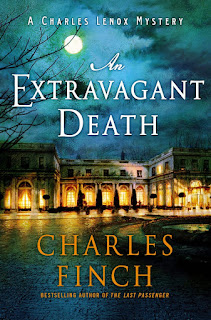
Charles Finch, AN EXTRAVAGANT DEATH


As always with Finch’s Victorian mysteries, this is an engaging and entertaining read, with the charming, urbane detective Charles Lenox, now middle-aged and married to Lady Jane and with two children, and with a narrator who delivers wry observations that make me chuckle inwardly as I read.


The book begins in London 1878 (a period I know and love). In the aftermath of a fictionalized version of the (true) corruption scandal that shook up Scotland Yard, Lenox’s potential presence at the trial is awkward, and PM Disraeli sends him off to America on a diplomatic mission. However, once in America, Lenox is waylaid by a case of murder, which takes him to Newport, where a young woman’s corpse has been found on the beach below the famous Cliff Walk. For those who are watching Julian Fellowes’s THE GILDED AGE, you will find some of the characters here, most notably Mrs. Astor who throws the ball that occurs toward the end of this book. 


One thing I love about the book is that Finch knows the period so well that the details that immerse us in this other world are feathered in organically, and I always learn something new. For example, the word “backlog” comes from the “back log” in a fireplace. Shrapnel—gunshot loaded inside hollow cannonballs—was created in 1784 by a lieutenant named Henry Shrapnel. There was a tavern in Greenwich Village where officers used to meet during the Civil War, with spies, “called the Old Grapevine” (hence the phrase, heard it through the grapevine). I always enjoy those tidbits, like a raisin in a scone. 


I also love the nimble, allusive language that captures nuances and small moments. Quoted passages are never as good out of context – but here are a few, just to give those readers unacquainted with Finch a sense for his prose. As the third one suggests, Finch has some of Austen’s tendency toward humorous understatement and shrewd observation of character.


“For the next two days London was layered in a fog so dense that according to the papers now fewer than eight men fell into the river from the West India Docks. All of them had been fished out quickly, fortunately, and none worse off than a glass of rum would cure, but as the papers said—still! A pretty pass things had come to, when men and women couldn’t walk the streets of the capital without the prospect of barging straight into a lamppost.” 


Regarding Delmonico’s in NYC: “Lenox might have queried the wisdom of police commissioners meeting in the same place as the criminals—but it fit in with New York, where everything seemed to happen inches from everything else.” 


“Most single young gentlemen of large fortune he had known were drunk with their own high valuation of themselves, knowing it was held by others too; few Mr. Bingleys to be found anywhere, at any time.” 


“… the article’s writer … was identified as J. Gossip Gadabout, a name which Lenox, with his years of practice in detection, strongly suspected of being a pseudonym.”


If you haven’t read the previous novels in the series, you can begin here; it works as a standalone. 

Monday, February 7, 2022

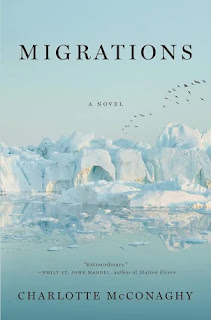
Charlotte McConaghy, MIGRATIONS


This is a powerful, beautifully written novel set in the near(ish) future when climate change has drastically affected the earth and rendered most species extinct. Franny Stone, the protagonist and an avid studier of birds, convinces the captain of a fishing boat to take her along on his journey south, claiming that her tagged birds will lead them to the ever-diminishing "big catch" of fish. In fresh, poetic language, Franny describes their journey as well as her past. She explains she grew up in "a wooden house so close to the sea I was able to tune my swift child's pulse to the shh shh of the neap and spring tides." Lovely descriptions are sprinkled on nearly every page: "the cold is familiar and savage," "the keening of the wind," "[we] watch dark stain the sky."

Some readers had difficulty with how much this book jumped around from present to various pasts, but that didn't bother me so much. The author wrote in a way that made me trust that they would all fold together by the end.

But [*spoilers ahead*] I found myself a bit overwhelmed by all the grief and past trauma. I know it's what people write now ... it has become de rigueur for everyone from writers of literary fiction to Ted Lasso to uncover a backstory element such as an abusive father or a lost mother or a near death experience in their childhood. I find myself growing restless in the face of it, especially when it isn't necessary to generate narrative power. In this book, Franny experiences at least 8 different serious traumas [*spoiler alert*] that we find out belatedly, as they take place before the timeframe of the story: childhood poverty and deprivation, a feeling of not belonging, a mother who abandons her, a father in jail, the death of her child, the death of her beloved husband, the death of two other people, and jail time and the violence that entails.

Early on she explains, "one way or another, when I reach Antarctica and my migration is finished, I have decided to die" and though it feels a bit melodramatic on page 27, by the end of the book I feel like her redemption and the happyish ending almost seems as unlikely as all the trauma that caused her original suicidal wish.

This isn't to say that horrifying things don't happen to people, and sometimes they happen in multiples. I wrote my PhD diss on Victorian railway disasters because I was interested in how the experiential category of "trauma" (and PTSD) evolved out of early medical and legal discourse used to address the bizarre and often belated injuries suffered by train wreck victims. The subject fascinates me, and I think we need to continue to examine trauma and its aftereffects on the psyche and the body (as well as to resist the tendency to think of every grief as traumatic; the term loses its usefulness). I just felt like I was getting a bit hammered by it in this novel. Other people will feel differently, I'm sure. This said, I would definitely recommend this book. There's so much good here -- it's eloquent and poetic, a book that made me think about our fragile world, and a page-turner all at once.

Thursday, February 3, 2022

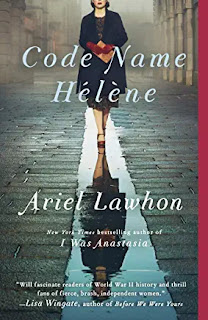
Ariel Lawhon, CODE NAME HELENE

 4.5.


I have to confess, I have felt a bit burned out on WWII books, with many books in recent years featuring women as spies, coders, secretaries, land girls, resistance fighters, parachuters, etc. But I appreciated this one. Like THE WOLVES AT THE DOOR, by Judith L. Pearson, about the (historical, real-life) American spy Virginia Hall, this book, based upon the Australian Nancy Wake, a newspaper free-lance writer turned resistance leader, has the feel of the real.

The book is well-written, well-researched, and engaging, and my gripes are small: at times, I found the language a bit fraught, loading up the emotions somewhat improbably and with references that feel somewhat forced. (From page 87: Frank opens his mouth and I know where he's going so I stick my finger right in his face. "Don't you dare say, 'But what about George Eliot?' Don't you dare! Mary Ann Evans made her choice and so did I!'") I wasn't sure what the narrative gained by the chapter-by-chapter shifting among years, from 1944 to 1936 to 1939. I also didn't understand why sections from Nancy's husband Henri are dropped in (with a rag-right margin instead of justified), as I felt they didn't add materially to the story. Still, it's an engrossing page-turner, and I recommend it.

Opening lines: "I have gone by many names. Some of them are real--I was given four at birth alone--but most are carefully constructed personas to get me through checkpoints and across borders. They are lies scribbled on forged travel documents. Typed neatly in government files. Splashed across wanted posters. My identity is an ever-shifting thing that adapts to the need at hand."

Monday, December 27, 2021

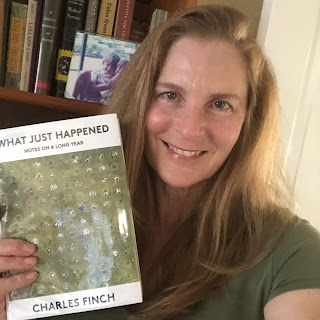
Charles Finch, WHAT JUST HAPPENED: NOTES ON A LONG YEAR


BOOK REVIEW ⭐️⭐️⭐️⭐️⭐️

I had the pleasure of meeting the mystery writer Charles Finch once, when the Poisoned Pen bookstore owner invited me (as another author who writes mysteries about Victorian London) to help interview him. That evening, Finch struck me as gracious, well-read, and comfortable in his own skin. He was on a book tour for The Last Passenger, one of the Charles Lenox mysteries, and I read some of my favorite passages from it aloud to the audience because they were wonderfully, wryly funny -- a tricky thing in murder mysteries. Pulling it off requires that a writer be keenly attuned to both emotions and language.

Perhaps unsurprisingly, Finch has written a memoir that is discursive, literary, allusive, and above all humane. His dated entries beginning on March 11, 2020 follow the linear historical trajectory of events including Covid, the presidential election, and the Black Lives Matter movement, but the entries aren't homogenized into a tidy whole. To me, they feel reassuringly raw and emotionally uneven--reassuring because this is exactly the way that I experienced the past 18 months, with that messy mixture of denial and isolation, anger, bargaining, depression, and acceptance and some hope and a load of anxiety thrown in. If this sounds like Elisabeth Kubler Ross's 5 stages of grief, that's because ... well, it's been a long, painful year.

Some of the reviews on goodreads have criticized Finch for his liberal views, which are earnest and heartfelt and may strike some people as strident. I'll admit, I don't wholly agree with some of the solutions he sketches, as he's addressing some complex problems, but I also felt that what he was capturing (successfully) was the impatience, the desperate longing for things to change *soon* that many of us feel.

As for the writing itself, his feelings and thoughts, his memories and experiences are limned in prose that makes me a tad jealous at his turn of phrase. (The passages about his grandmother are especially tender.) It's the sort of book that makes me want to be a better writer, to be more precise with my own language, not to be lazy, but to find just the right metaphor to reflect human experience in a fresh, true way. He references cultural icons and books (so many books! I found myself thinking, How does he have time to do anything other than read?!) from Aslan to A Tree Grows in Brooklyn, and I came away feeling as though I'd spent several hours with a lively intellect, someone honest, someone I'd like for a friend -- and having been reminded that shared stories and books are some of the nodes around which we can gather, to undo that feeling of isolation and get through this together.

Highly recommended.

Sunday, November 28, 2021

Edwin Hill, THE SECRETS WE SHARE

I've enjoyed Hill's previous books, but this is hands down my favorite. It's a twisty tale -- and the narrative power comes not so much from the unexpected reveals and startling violence but from a rich backstory of pain and trauma, secrets and misunderstandings. As a result, the emotional lives of the characters feel complex enough to justify the longings they feel, the motives that compel them, and the risks they take. As with Tana French's debut, IN THE WOODS, the characters at the center of this story are now grown but had an experience as children that shaped their lives in profound and troubling ways. The two sisters, Natalie and Glenn, have coped with tragedy differently, but Natalie's tendency toward depression and Glenn's almost frantic self-promotion are flip sides of the same coin. Psychologically coherent and intense, this novel is a great read for mystery fans. 

This book will be available in March or April 2022.

Wednesday, November 24, 2021

Emily Arsenault, THE LAST THING I TOLD YOU


I'll be honest -- I don't tend to gravitate toward thrillers, and I probably wouldn't have picked up this book except that I met the writer at a conference and thought, She's smart and insightful; I bet she's written a good book. And in my opinion, it *is* good, but (reviews including the one by the wonderful Hallie Ephron notwithstanding) I wouldn't categorize this novel as a "thriller." That label sets up expectations of a racing pace that this book doesn't really meet. However, the novel does succeed in excavating a young woman's traumatic childhood, exploring a teenage girl's emotional muddle surrounding a drastic and violent act, and portraying the ensuing multi-layered therapy relationship as well as allowing the reader the vicarious pleasure of solving the murder mystery along with a likable, humane detective. Indeed, in alternating between two narrators--Henry, the detective investigating the therapist Mark Fabian's murder, and Nadine, the traumatized woman who was once Mark Fabian's patient--the book in some ways reproduces the structure of therapy and suggests that in both therapy and detective work, the process toward resolution is the same: assembling a linear and plausible narrative out of scraps.


One of the issues I have with many books that depict therapy is they tend to follow a rather idealized trajectory -- such as in Good Will Hunting, where Robin Williams plays the engaging and wise therapist and Matt Damon plays the young man who reaches the necessary epiphany as a result of their time together, and then drives off into the sunset to find the girl. I'm not griping about Good Will Hunting, which is heartwarming and enjoyable. But Arsenault's book offers something more nuanced: it examines a therapy relationship that feels genuine and authentic, between an imperfect therapist (with emotional fatigue and memory issues) and a patient who does not transcend her demons by the end of their sessions.

For me, Arsenault's strength is her ability to portray the inner workings of Nadine's mind. It's never quite fair to take a passage out of context (it often doesn't "show" well), but I'm going to include one here, just to demonstrate what I mean. This is Nadine: "As a good and proper therapy patient, one tries, most of the time, not to go to these places in one's head. But you do. Your brain wants to do it, just because it knows it's not supposed to. Like when you're in Sunday school class as a kid, and the old lady teaching the class says that God sees and knows everything, even what's in your head, and then your head just keeps thinking I hate Jesus, I hate Jesus, I HATE JESUS! Not because you really hate Jesus (because what is there to hate about long hair and love and crucifixion?) but because God is listening and your brain just wants to screw you over for some reason that you will never--even decades later--ever understand."

There is a raw humanity and a psychological complexity to both Henry (who has his own baggage) and Nadine that I appreciated. For that reason alone, I found myself wanting to see how it all turned out. I'll definitely look for more by this author.
 

Monday, November 8, 2021

Sigrid Nunez, THE FRIEND


A tender, delicately wrought, deeply humane novel that purports to be a memoir by a woman writer who inherits a huge Great Dane named Apollo from a friend who commits suicide. (There's a twist at the end, but no spoilers here.) One aspect I loved was how immersed, even steeped, the book is in the writing life--the anxiety and frustration inherent in the creative process, reading books, writing books, receiving reviews, teaching creative writing, writing letters of recommendation for students trying to get into MFA programs, etc. Nunez also drops in the references to books (Unbroken), poems ("September 1, 1939"), plays, and literary figures, but deftly. I felt none of the sense that she's doing it to prove how much she's read (ugh); instead, she drops in just enough information that you feel included in her circle.


I read this book in a single day and enjoyed it (I was hurrying for bookclub); then I went back and reread parts today and found I appreciated it even more. Highly recommend to my writer friends and dog lovers.
 

Sunday, October 10, 2021

Abi Daré, THE GIRL WITH THE LOUDING VOICE


A strong and poignant debut set in Nigeria in around 2015, about Adunni, a fourteen-year-old Nigerian woman, married off by her father to be a third wife to an old man. Adunni only wants to go to school, maybe even become a teacher to help improve the lot of other young women, but she is trapped in what appears to be an inescapable cycle of abuse and poverty.

Somewhat as in the novel THESE IS MY WORDS, language is central to the narrator's self-actualization and empowerment. Adunni's language (the novel is told in first person) is at first broken and uncertain--though her observations are apt: "Papa like to be sitting in front of the fan in the evening ... drinking from the bottle that have become his wife since Mama have dead." But gradually, Adunni's language gains assurance and skill, as she learns about the world and finds a place for herself in it, eventually writing her way into a better, happier situation. A quick, satisfying read, and I'm looking forward to talking about it at my book club. 

First lines: "This morning, Papa call me inside the parlor. He was sitting inside the sofa with no cushion and looking me. Papa have this way of looking me one kind. As if he wants to be flogging me for no reason, as if I am carrying shit inside my cheeks and when I open mouth to talk, the whole place be smelling of it."

Tuesday, September 7, 2021

Edwin Hill, WATCH HER


Edwin Hill’s WATCH ME, a contemporary thriller set in Boston, centers on a for-profit university and its owners and students—and a crime committed years ago that was covered up by layers of lies. It is told from the alternating perspectives of Angela (a detective), Hester (a missing persons specialist), Barret (a transgender student), and Maxine (who helps run the university). Through their different perspectives, Hill illuminates how one small, terrible incident years ago can have effects for a large web of people, and how the characters (and we) all carry our baggage—divided loyalties, unfulfilled longings, childhood guilt, and questions of identity. The ending has a twist I truly did NOT see coming. Yow! 

Those who like contemporary thrillers will find this a quick, engaging read. I'd say this is a good fit for fans of Hank Phillippi Ryan, Lisa Unger, and Hannah Mary McKinnon. 

Wednesday, September 1, 2021

Paula McLain, WHEN THE STARS GO DARK


This is a departure from McLain's previous works of historical fiction (such as THE PARIS WIFE and CIRCLING THE SUN). This is a thriller based upon real events and set in 1993, just before the internet makes finding missing persons a different kind of task. 

The protagonist, Anna Hart, a missing persons detective living in San Francisco, has left her family behind after a tragic accident kills her daughter, and she goes to Mendocino, a former home town, to grieve. There, a constellation of cases of missing girls draws her in, and in working through them, she confronts her childhood traumas from life in foster care. 

For me, what makes this an unusually strong thriller is the level of writing, particularly the internal monologue, which often feels pitch-perfect, precise and elegant, even poetic. Quotes are never as powerful out of context, but here are some samples:

"[I felt]... a sadness that seemed to settle into the space between the trees, between the trunks and branches, between the needles and leaves, between the molecules. It climbed inside my body and curled up tightly under my ribs, like a fist made of silver thread."

"When things got hard and you felt shaky, she liked to say, you could hit your knees wherever you were, and the world would be there to catch you."

"What is all the suffering for if not so we can see how alike we are, and not alone? Where will the mercy come from, if not from us?"

Ambitious in its themes and compassionate and humane in its ethos, I think this book will appeal to fans of Tana French and Louise Penny.